Early Years
What is the Early Years Foundation Stage (EYFS)
The Early Years Foundation Stage applies to children from birth to the end of the reception year.
At Much Birch Primary School children are admitted to reception in the September following their fourth birthday.
Principles of EYFS
The Early Years Foundation Stage is based on four themes:
- A Unique Child
- Positive Relationships
- Enabling Environments
- Learning and Development
The early-years education we offer our children is based on the following principles:
- It builds on what our children already know and can do;
- It ensures that no child is excluded or disadvantaged;
- It offers a structure for learning that has a range of starting points, content that matches the needs of young children, and activities that provide opportunities for learning both indoors and outdoors;
- It provides a rich and stimulating environment;
- It acknowledges the importance of a full working partnership with parents and carers.
Our Philosophy
Early childhood is the foundation on which children build the rest of their lives. At Much Birch Primary School we greatly value the importance that the EYFS plays in laying secure foundations for future learning and development.
However, we also believe that early childhood is valid in itself as part of life. It is important to view the EYFS as preparation for life and not simply preparation for the next stage of education.
Our Aims
We aim to support all children to become independent and collaborative learners. We will provide a broad and balanced curriculum that will enable each child to develop personally, socially, emotionally, spiritually, physically, creatively and intellectually to their full potential.
At Much Birch Primary School, we will:
- Provide a happy, safe, stimulating and challenging programme of learning and development for the children to experience as they begin their journey through school.
- Provide a broad, balanced, relevant and creative curriculum that will set in place firm foundations for further learning and development in Key Stage 1 and beyond and enable choice and decision making, fostering independence and self-confidence.
- Use and value what each child can do, assessing their individual needs and helping each child to progress.
- Develop excellent relationships with parents and carers to build a strong partnership in supporting their children.
- Provide a caring and inclusive learning environment which is sensitive to the requirements of the individual child including those who have additional needs.
What does the EYFS look like at Much Birch School?
We know play is a vital part of learning. So through planned play, our children explore and develop their learning experiences, which help them to make sense of the world. They practise and build up ideas and learn how to control themselves, take responsibility for their actions and understand the need for rules. We give them the opportunity to think creatively alongside other children as well as on their own. We support and encourage our pupils to communicate with others as they investigate and solve problems. We provide a safe and nurturing environment that promotes and encourages our pupils to express themselves freely and share any fears they may have with confidence and allows them to make any mistakes in a controlled and safe way.
In the EYFS we consider and plan for Substantive and Disciplinary Knowledge.
Substantive Knowledge
Substantive knowledge In the EYFS, substantive knowledge is the understanding and use of knowledge across the seven areas of learning. In the prime areas, this is how to listen, speak and communicate effectively, how to manage self-care needs including dressing, managing their hygiene and how to control their bodies. It also refers to personal, social and emotional development including how to make and maintain relationships, manage feelings and behaviour and build confidence and self-esteem. In the specific areas, substantive knowledge is the area specific understanding and use of key concepts which are taught sequentially through adult-led teaching and those which also naturally arise through child-initiated learning. Development of the substantive knowledge is achieved through deliberate practice so that children develop fluency in their knowledge and understanding.
Disciplinary knowledge
Disciplinary knowledge In the EYFS, disciplinary knowledge is the interpretation and independent use of learnt knowledge and skills. Embedded learning is identified by assessing what a child can do consistently and independently in a range of everyday situations. Disciplinary knowledge is also represented by children’s independent use and application of the prime and specific areas of learning. Examples include using substantive knowledge of colour mixing in their own paintings or applying phonic knowledge to read their own independent writing.
Cultural Capital In the EYFS
What is cultural capital in the early years?
In the EYFS, cultural capital means that each child arrives with a number of experiences and ideas based on their own personal circumstances.
It is the essential knowledge that children need to prepare them for their future success. It is about giving children the best possible start to their early education.
When children arrive at Much Birch School we understand that the interactions with parents and previous settings is key to the ease of transition into school. It makes all the difference to the settling in of the children.
Building a positive relationship with parents/carers and preschool settings opens up a dialogue to benefit the children.
Visits are arranged for the Reception teacher to spend some time at the child's preschool and additionally for the parents to visit Much Birch with their child through a 'Teddy bear's picnic'. This enables the partnership between the family and school to begin.
At Much Birch we provide exciting and stimulating activities to broaden children's experiences such as trips to farm parks, the local library, parks, woods and bring experiences into school through visitors such as fire engines, paramedics, vets, nurses, police, theatre groups, hands-on science activities.
Our weekly forest school sessions promote risk taking, cooking, building, story-telling, poems and an awe and wonder of our world.
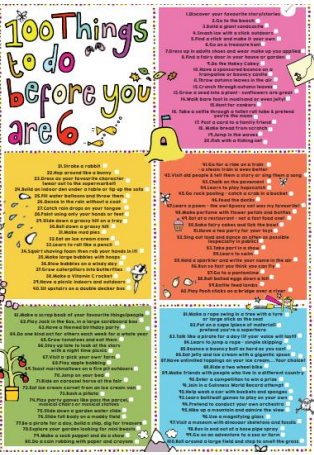
Please see some activities below for children to build up their experiences and develop their personal, social and emotional development. Partnership between home and school to provide a wealth of experiences greatly benefits the child.
At Much Birch we understand the need to provide a welcoming transition for all who join our school.